March 13, 2012

3-Day Portrait Sculpture Challenge

Students in grades 7-8 learned about busts and portraits as an introduction to sculpture and clay.
The first day they learned how to create the generalized proportions of the human face. 
Next, they each received a photograph of a famous person, and embraced the challenge of recreating that famous face to the best of their ability in clay. 


Students had to observe the famous faces closely, and notice all of the small things that makes each face unique.


Both myself and many of the students were impressed by the clay portraits they made in only 3 class periods.  Many of the students had never sculpted with clay before.


Two "Rosa Parks" by one 7th and one 8th grader

Pablo Picasso- amazing job by Jerry.

February 12, 2012

The finished Autobiographical Comic Strips

I thought I would post some images of some of the completed comic strips created by the 6-8th grade students.  Many of the students worked very hard on these, and they did a fabulous job telling their true story using pictures and words in tandem.  


Throughout this project, the students learned about thumbnail sketches, planning out a work of art, comic book conventions such as including panels and gutters, zooming in to the action, communicating through facial expressions, and varying your line weight. Students also learned how to use lines to create value.  Finally, I hope they learned that even if they can't draw perfectly or realistically, they can still use simple images to communicate a whole lot of (true) story and (hilarious) information to a viewer. 


Finishing Our Shadow Puppets

Students in the 3rd and 4th grades have now added color and details to their shadow puppets, making them enticing art objects as well as fabulous shadow play.  They chose either colored pencils, markers or both to bring their characters to life.  


A completed donkey puppet created by Alexander in 4th grade,  next to his original drawing and design.


Next, they joined each of their separately drawn and cut pieces together, using paper fasteners.  Next week, students will add the dowel rods to their puppets and begin rehearsing movements that tell the story of their folktale. 


A completed bird puppet by Alicia in 4th grade. 
Many of the puppets came out absolutely superb from the standpoint of successful engineering and design, as well as beauty and characterization. 
I will be posting more pictures of both the puppets and performances soon.

Here are links to some of the performances:  More to come!
http://www.youtube.com/watch?v=1jx7NAOYcwk&feature=youtu.be 

http://youtu.be/6Nm5qkKbqMQ

January 21, 2012

Designing Puppets Based on Folktales

After creating practice puppets to understand how shadow puppets are put together, students in the 3rd and 4th grade are now creating shadow puppets of their own design based on folktales and fables.  We are using Rudyard Kipling and Aesop's fables as our main source of story.  
Traditional Indonesian shadow puppet
Students from each class are working in groups. Each group has its own story and each student is creating a character within that story. 

The first step was for students to read the stories aloud and identify who the characters are and who would create each character. They also summarized the story.  Next, students learned about the words characteristic and trait, and they brainstormed four characteristics their puppet would have. 


Next, the students created a sketch for what they thought their puppet could look like.  Some students used pictures of animals as a reference.   I also talked to students about how they should plan ahead of time, and be thinking about which part of the puppet would move. 


Students showed their thinking and plan for how their puppet will move by drawing circles to indicate where they will use paper fasteners to create a movable joint.  


Currently, the students are drawing their design on thicker card stock, being sure to draw their moving parts separately.  The students are doing a lot of problem solving to create successful puppets.


January 15, 2012

The Artist(s) of the Month

Beginning in November, we have a new tradition at Coonley school, where 1-4 students each month get to display the art they make on their own time (not in art class) on a bulletin board in the 1st floor hallway.  The idea is to showcase students who are actively practicing their drawing, painting and collaging outside of school, and to have other students admire and learn from their work.  I wish we could accommodate sculpture as well, but we only have this bulletin board for now.  

Dominik was the pioneer who paved the way with style! (November)


To become an artist of the month, students who are interested show me six pieces of art they have made, and if they are good quality, we decide on a month during the school year that will be theirs.  They also write an artist statement to accompany their work.
So far the artists have been Dominik in 5th and Lexi in 6th.   

Autobiographical Comic Strips

Students in the 5th- 8th grades have been working on autobiographical comic strips over the past month or so.  We began by looking at the work of artist Heather McAdams. 


Based on the project Heather McAdams created for Spiral Workshop at UIC, Coonley students answered questions and selected a true story based on themes such as an animal encounter they exprienced, something they were afraid of, a moment of triumph, etc.


Next students learned about the word thumbnail sketch and panel, and they began laying out their story into panels (frames) and narration.    Some students wrote before drawing, and others drew the pictures first. Students continued to refine their ideas based on feedback from their peers and teacher, as they worked hard to communicate their story in pictures and words. 


Next, the students moved on to laying out their final panels on illustration board, leaving neat "gutters" (spaces) in between each panel.  They worked to make their drawings more detailed than the thumbnail sketches, and added backgrounds and more facial expressions to tell their story.  We talked about zooming in and out, and getting down to what is essential about each moment.   


Next up, students will learn to ink up their panels, using permanent marker, and building off of the skills they acquired when they practiced contour line drawing.  They will also learn how to shade (create different values) using only lines, and will apply that skill to some panels in their comic.


Next, students completed this worksheet to practice using lines to create value.  The more lines you gather together and the closer the lines are to each other, the darker the value (shade) appears to be. 


January 14, 2012

Collaging and Finishing Our Illustrations

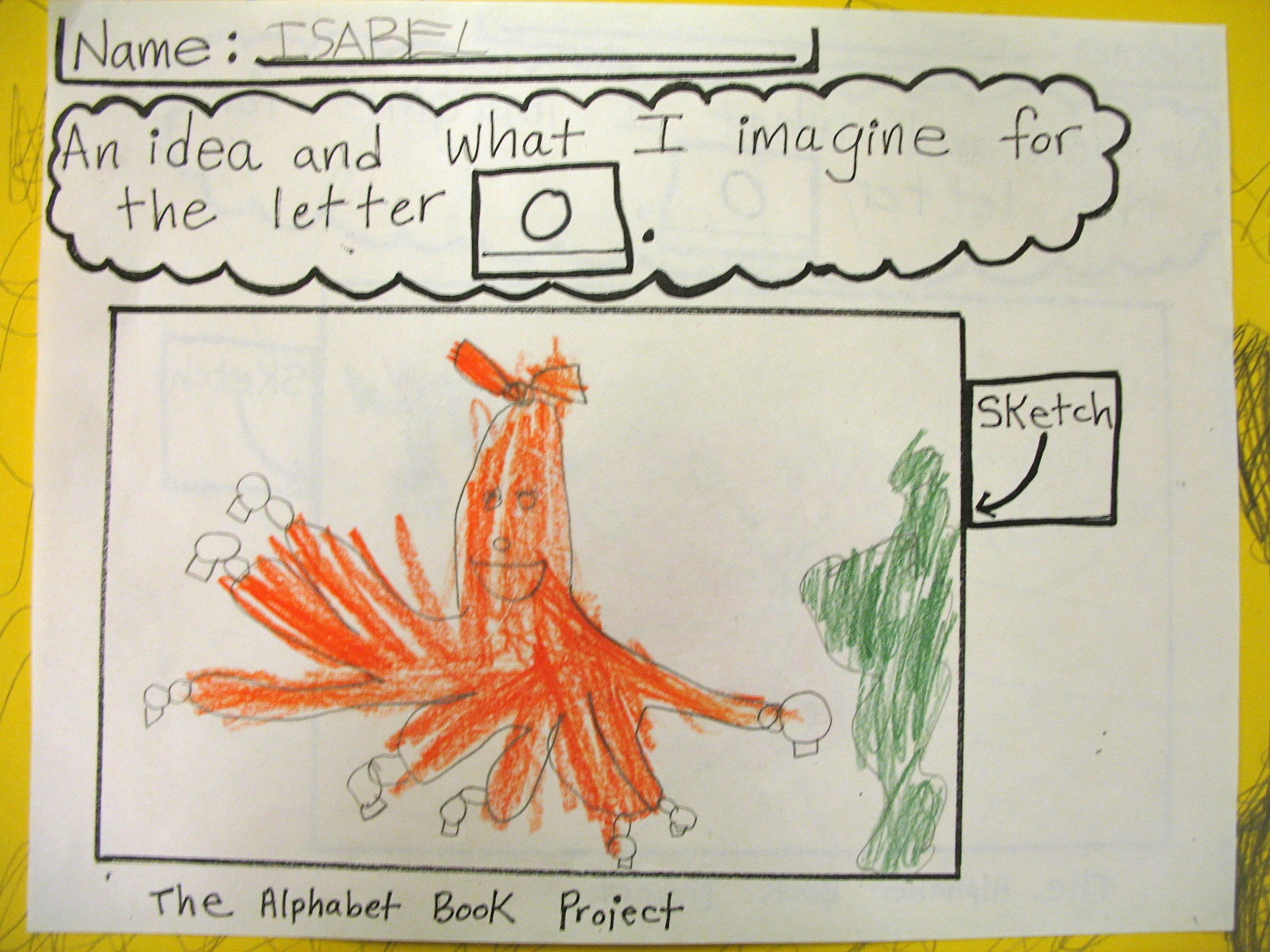
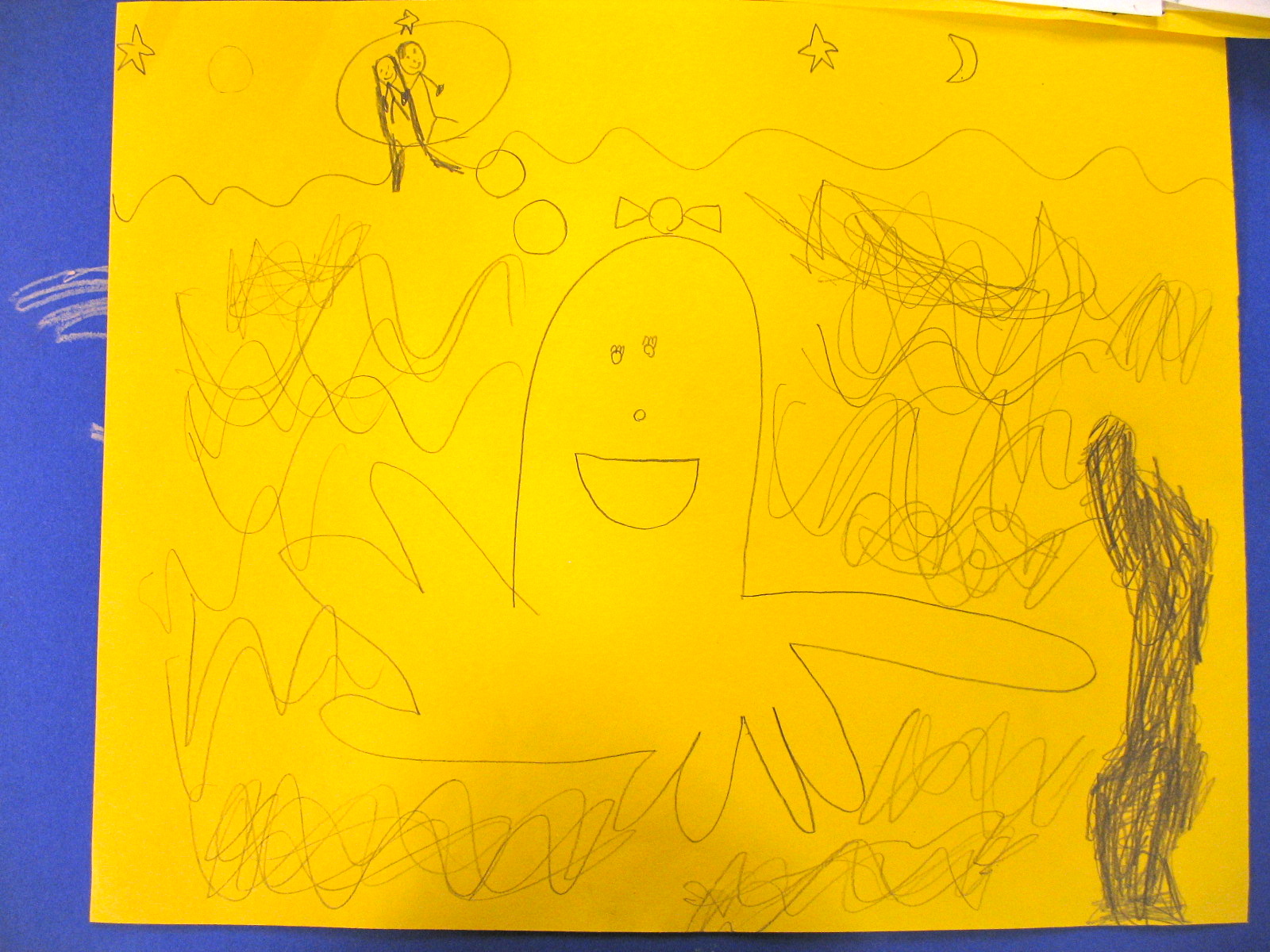
After kindergarteners, 1st and 2nd graders envisioned their ideas for their book illustrations, they drew their idea on a larger sheet of construction paper.  There were several tools I introduced to the students in order to help the them scale up their original drawings.   In some cases they looked for basic shapes, and in others they divided their sketch into four parts, and used a grid as their guide. 

"O" is for Octopus


Next, students began looking for large shapes in their drawing, that they could cut out of paste paper and collage onto their illustration.  The students accessed the paste paper themselves, choosing the color and texture that helped them express their idea.  

"U" is for Umbrella


T is for Truck


This is an illustration for the verb "flying".

 Next, over the last two class sessions, students used black markers, oil pastels and colored pencils at several different stations in the art room, and added to their collage in order to complete their illustrations and fully express their ideas.  Students learned about the word "mixed media" to describe the use of multiple materials in one piece.


"F" is for foot!


"V" is for vampire!