This week has turned out to be a short week because of the snow blizzard. Chicago Public Schools had two whole days off! This is unheard of, but it's a very welcomed phenomenon for all the kids (and adults).
On Monday kids continued to work in the open studios to finish up the pieces they have started. Kindergarten and 1st grade continued to reflect on their work in teams, using a modified version of the Art Sandwich. Ms. Kitty had the brilliant idea to further simplify the Art Sandwich by turning it into manipulatives. We used construction paper to make bread and meat/cheese. While the students were gathered at the rug, we discussed what a compliment is and practiced giving compliments and suggestions for improvement as we looked at an art piece. Ms. Kitty and I then helped groups of four students give an Art Sandwich to one member of their group. The artist talked about their work first, for one minute, and then each of the three students giving feedback verbalized and wrote a compliment or suggestion.
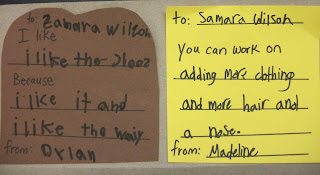 |
1st grade students write what they like about Samara's artwork (bread) as well as something she might be able to work on (cheese).
|
I am so impressed by even very young students' ability to reflect on their work and give others thoughtful feedback.
I know many teachers don't have young kids think about their artwork and engage in critiques, but in Ms. Kitty's room, she starts them out young, and I really think it's a great benefit to the students.
 |
| 1st grade students look at an art piece and give each other feedback using an Art Sandwich made from three pieces of construction paper. |
|
On Tuesday I did get to implement the first mini-project I devised for the 5th graders. Unfortunately, there are two 5th grade classes which we only get to see 3-4 times over the 7 weeks I am student teaching, due to the fact that many of their art days fall on holidays or professional development days.
Because of this, Ms. Kitty and I decided that the students should engage in weekly sculpture challenges, where they would complete the challenge in one class period.
The goal of these sculpture challenges is to have students become more comfortable with thinking on their feet and with creating 3-D forms in the construction studio.
This first challenge was built on students' prior knowledge of how nets (flat templates) create 3-D solids. The students had recently engaged in an activity where they matched nets to their respective solids, as well as drew three-dimensional forms on paper using shapes such as rhombuses and trapezoids.
5th grade students in this 1st Sculpture Challenge were told at the rug that they 30 minutes to create a sculpture based on one of three geometric forms. We began at the rug by looking at the book:
which is geared towards small children but is wonderful for any age to demonstrate how depending on the viewpoint you look at something from...
it can be completely transformed.
We then looked at a pencil case and discussed what objects it could become if it had a different skin. Skin is what Ms. Kitty calls the surface treatment. We also discussed how sometimes artists have strict deadlines to adhere to, and they have to be creative in a very short period of time.
Students were told they would have 30 minutes to trace one of three nets, envision what that geometric solid could become, and create the skin so that the audience could see their vision.
I donned a whistle and talked about how this contest was like Project Runway or Top Chef, and when the clock runs out, every student was to place their sculpture on the blue table and we would vote for the one that was most successful. The students really grasped on to the fun of working quickly, and they hurriedly worked either alone or in teams of 2 or 3 (their choice) to meet the challenge in 30 minutes.
In the end, a sculpture called Girly Girl Bed got the most student votes, followed by a robot and a jack in the box in second and third place.
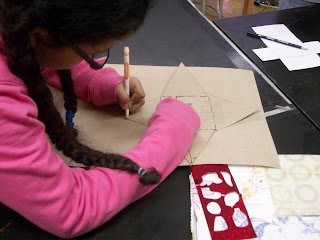 |
| Students begin by tracing a net (template) of their choice. This student chose a pyramid as her solid. |
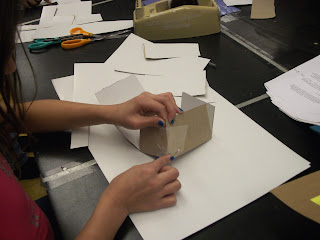 |
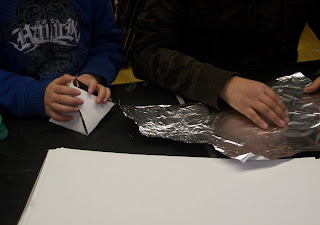
| Next, students taped their nets together to form a solid. |
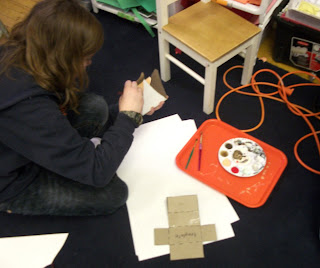 |
| Students used any studio; construction, fashion, painting, or collage to add a skin to their solid in order to turn it into a recognizable object. |
 |
| Students worked in teams if they chose to. Some teams worked seamlessly and others struggled to agree. |
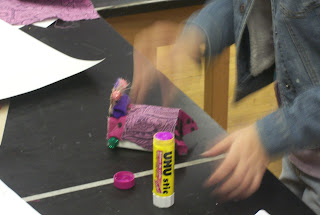 |
| These girls used the fashion studio to add bed covers and pillows to their Girly Bed. Time is almost up! |
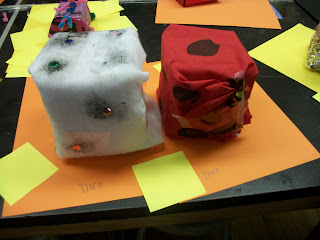 |
| One of the final pieces, Two Dice. |
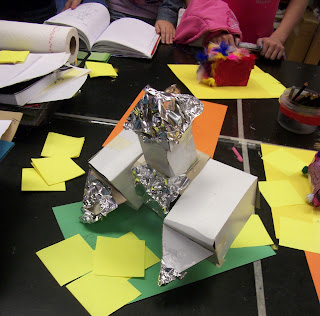 |
| The Robot, created by combining several solids and using foil as a skin. We voted using post-it notes if you're wondering what all the mess is. |
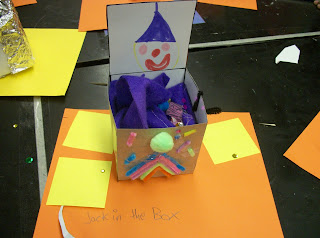 |
| The Jack in the Box. Created using multiple studios for skin. |
 |
| Top view of the Girly Girl Bed, as well as a Messed Up Couch, a Pyramid, and a Shoe Box. |
Next time we see them,
the students will work on Sculpture Challenge #2!


